By Jesse Bravo | MktProFin · November 10, 2026
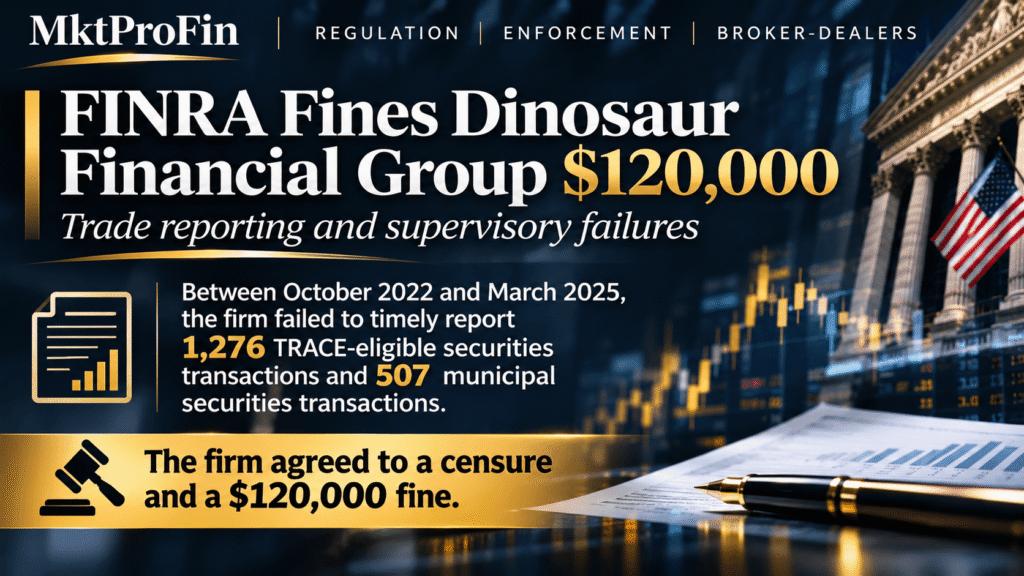
FINRA fined New York-based Dinosaur Financial Group $120,000 after finding late trade reports and deficiencies in the firm’s supervision. The firm also agreed to a censure.
The settlement shows how missed fixed-income reporting deadlines can become a broader compliance problem when a firm lacks controls to detect recurring violations.
What FINRA Found
From October 2022 through March 2025, Dinosaur Financial Group failed to report 1,276 TRACE-eligible securities transactions by the applicable deadlines, according to FX News Group’s coverage of the settlement. The firm also reported 507 municipal securities transactions late during the same period.
TRACE, the Trade Reporting and Compliance Engine, collects transaction information for eligible fixed-income securities. FINRA Rule 6730 governs reporting for TRACE-eligible transactions. Municipal securities transactions carry separate obligations under Municipal Securities Rulemaking Board Rule G-14 and are reported through the Real-Time Transaction Reporting System.
Timely reporting supports regulatory oversight and price transparency. When late reports recur, firms need to know where the delay starts and whether the same issue affects other trades.
Supervisory Procedures Under Scrutiny
FINRA also found deficiencies in the firm’s supervisory system and written supervisory procedures for both reporting obligations. FX News Group reported supervisory violations under FINRA Rule 3110 and MSRB Rule G-27.
A written procedure can assign responsibility for reporting, but supervisors still need a way to identify late submissions and see whether employees resolved them. For example, if one trade feed repeatedly arrives after the reporting deadline, correcting the individual reports leaves the source of the delay in place.
Dinosaur Financial Agrees to a Fine and Censure
Dinosaur Financial Group agreed to a $120,000 fine and a censure. A censure is a formal regulatory sanction. The settlement addresses both the trade reporting violations and the weaknesses in the controls designed to prevent them.
Enforcement actions become part of a firm’s compliance history. Institutional counterparties and prospective clients can consider those records when assessing a firm’s operations and controls.
What Broker-Dealers Should Review
First, reconcile the firm’s trade records against reporting acknowledgments. Check whether the process captures all eligible transactions and whether the firm submits them by the applicable deadlines.
Second, assign responsibility for exception reports. Make clear who reviews late, missing or rejected reports, when they escalate recurring problems and who verifies the fix.
Third, compare written supervisory procedures with the workflow employees use. If a trade feed, reporting vendor or team assignment changes, confirm the procedures still reflect the process.
Finally, document how the firm investigates and resolves each reporting failure. Record the cause, the corrective action and any follow-up testing. This gives supervisors a way to distinguish a one-time error from a recurring problem.
Why This FINRA Settlement Matters
Trade reporting is a routine obligation for broker-dealers in fixed-income markets. Late submissions can accumulate across reporting systems if supervisors lack a way to identify patterns and act on them. Regular testing can show whether controls catch exceptions early and whether corrective action addresses the source of the problem.
For more reporting on broker-dealer supervision and enforcement, see MktProFin’s FINRA coverage.
Source: FX News Group, November 10, 2026.