By Jesse Bravo | MktProFin
November 12, 2026
The Securities and Exchange Commission brought significantly fewer enforcement actions against publicly traded companies in fiscal 2026, raising questions about how the agency intends to police corporate misconduct under Chairman Paul Atkins.
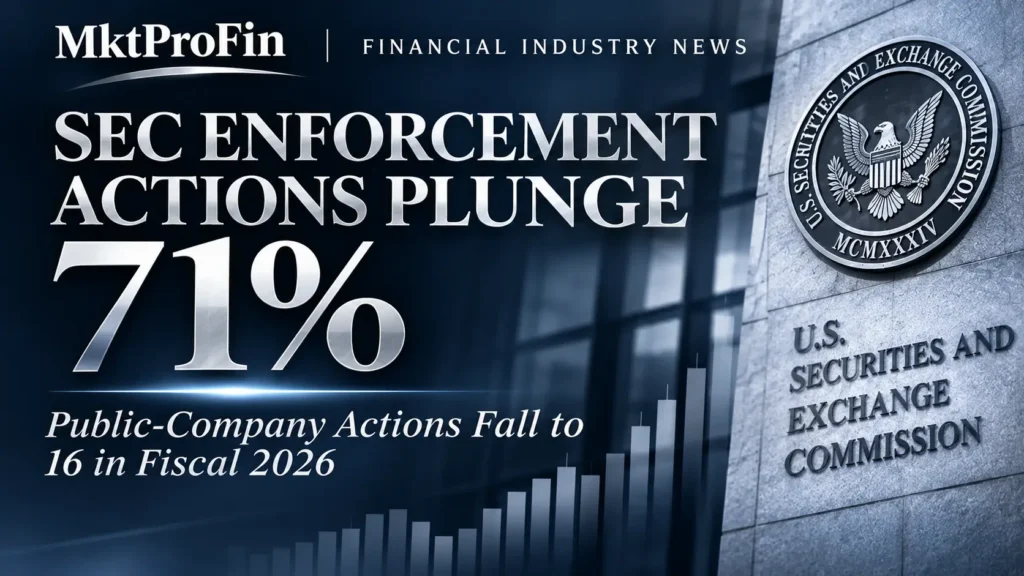
New research from Cornerstone Research and New York University’s Pollack Center for Law & Business shows enforcement actions against public companies and their subsidiaries fell 71%, from 56 in fiscal 2025 to just 16 in fiscal 2026.
It was the lowest annual total since researchers began tracking these cases in 2010.
For Wall Street, the numbers suggest a significant change in regulatory priorities. But fewer enforcement actions do not necessarily mean the SEC is abandoning oversight.
SEC Enforcement Falls to Historic Low
The decline extends beyond the number of cases filed.
According to the research, monetary settlements involving public companies and their subsidiaries totaled $184 million in fiscal 2026, the lowest amount recorded in the database.
That represents a decline of more than $600 million from the previous year.
The average settlement dropped from $15 million to $12 million, while the median settlement fell from $4 million to approximately $1 million.
These figures suggest the SEC pursued fewer cases and obtained smaller financial settlements.
One particularly interesting finding involves the number of defendants who paid financial penalties.
Only 63% of settling defendants faced monetary settlements, compared with an average of 92% between fiscal 2017 and fiscal 2025.
The change raises an important question for corporate compliance departments. Is the SEC becoming more selective about which violations deserve financial penalties?
Paul Atkins Changes the SEC’s Enforcement Approach
Chairman Paul Atkins has emphasized a different approach to measuring regulatory success.
Rather than judging the enforcement program by the number of cases filed, the SEC leadership has placed greater emphasis on the nature and significance of the misconduct being pursued.
This distinction matters.
A regulator can bring hundreds of relatively minor cases without necessarily addressing the most damaging misconduct in financial markets.
Conversely, a smaller number of significant cases can have substantial consequences for companies, executives and investors.
The challenge is determining whether the agency’s new approach produces stronger enforcement outcomes over time.
The fiscal 2026 data provides an early indication of the shift, although it cannot establish whether investor protection has improved or weakened.
Accounting Fraud and Corporate Disclosures Remain Priorities
Despite the overall decline, certain types of enforcement activity remain prominent.
Half of the SEC’s fiscal 2026 actions against public companies and subsidiaries involved issuer reporting and disclosure allegations.
That compares with 39% in fiscal 2025.
These cases can involve financial statements, corporate disclosures and information investors rely on when making investment decisions.
The growing percentage suggests the SEC continues to prioritize the accuracy of information provided to shareholders.
The research also found that a larger proportion of cases named individual defendants than in any of the previous ten years.
This development deserves attention from corporate executives.
A company might face fewer enforcement actions across the industry, but individual officers and employees can still face personal accountability when regulators identify misconduct.
For public companies, accurate disclosures and effective internal controls remain essential.
What the Numbers Mean for Wall Street
Investment banks, broker-dealers, registered investment advisers and public companies all operate within a regulatory environment influenced by SEC enforcement priorities.
But there is an important distinction in this report.
The 71% decline applies specifically to enforcement actions involving public companies and their subsidiaries.
It does not represent a 71% reduction in all SEC enforcement activity. The SEC separately reported 348 enforcement actions across its full program in fiscal 2026.
The agency separately oversees investment advisers, brokerage firms, investment funds and securities market participants.
Financial professionals should avoid interpreting the findings as evidence that regulatory scrutiny has disappeared across the industry.
For wealth management firms and RIAs, the practical approach remains straightforward.
Maintain accurate records, supervise employees, review marketing communications and address potential conflicts of interest.
A change in enforcement philosophy does not eliminate existing securities laws or fiduciary responsibilities.
Cooperation Could Become More Important
Another finding involves how the SEC evaluates companies that cooperate with investigations.
Researchers found that 53% of defendants in settled actions received acknowledgment of cooperation, compared with a 66% average between fiscal 2017 and fiscal 2025.
At the same time, 16% of settling defendants received cooperation recognition without an accompanying monetary settlement.
That was the highest percentage recorded since 2010.
For corporate legal and compliance teams, these figures suggest voluntary disclosure, remediation and cooperation deserve close attention.
The possibility of reduced penalties can influence how companies respond after discovering potential violations.
Still, firms should not assume cooperation automatically eliminates financial consequences.
Every enforcement matter depends on its specific circumstances.
A New Direction for SEC Regulation?
The SEC’s fiscal 2026 enforcement figures mark a significant departure from recent years.
Sixteen public-company enforcement actions, $184 million in monetary settlements and a greater emphasis on individual accountability point toward a more selective regulatory approach.
Whether this strategy ultimately strengthens market integrity will depend on the cases pursued, the misconduct prevented and the outcomes achieved.
For financial professionals, the message is clear.
The SEC is changing how it approaches enforcement, but the industry’s obligation to maintain accurate disclosures, effective supervision and strong compliance programs remains.
MktProFin will continue monitoring SEC enforcement trends and their implications for America’s financial professionals.