By Jesse Bravo | MktProFin
November 13, 2026
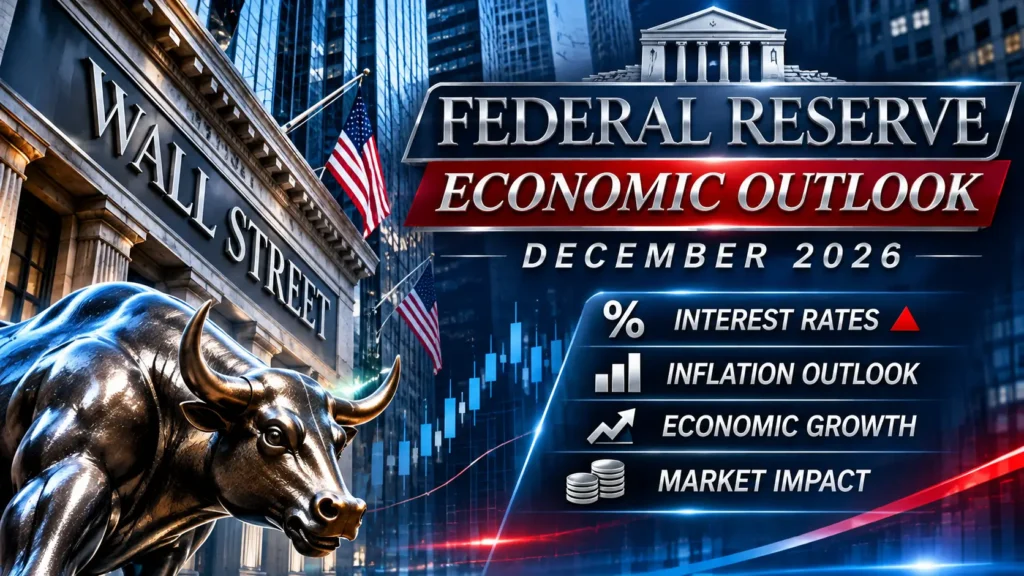
The Federal Reserve outlook for December 2026 poses a familiar problem for investors. Inflation remains stubborn, the labor market has held up, and Wall Street still has to price the risk of higher borrowing costs heading into 2027.
The central bank’s December 8–9 meeting is its last scheduled policy decision of the year. The question is whether inflation has cooled enough for the Fed to hold steady or whether policymakers see a case for another increase. The answer will shape expectations for Treasury yields, corporate borrowing costs and stock valuations.
Inflation Remains the Fed’s Biggest Problem
The Federal Reserve targets 2% inflation over the longer run, measured by the personal consumption expenditures price index. In its October policy statement, the Fed said inflation remained elevated and kept its target range at 3.75% to 4.00%. Two policymakers preferred a quarter-point increase.
Resilient demand supports growth, but it can also give businesses room to maintain higher prices. Services inflation can be particularly persistent. October’s core consumer price index rose 0.3% from September, according to Reuters. The CPI reading offers one measure of price pressure alongside the Fed’s preferred gauge.
For households, higher rates can keep credit card debt and car financing expensive. Mortgage rates also respond to longer-term yields and mortgage market conditions. For businesses, higher refinancing costs can delay expansion or change the economics of a project already underway.
Federal Reserve Outlook December 2026: The Interest Rate Decision
Investors have three things to watch: the target range, the statement’s description of inflation and employment, and the updated economic projections for 2027. Chair Kevin Warsh’s press conference could matter as much as the decision itself.
A quarter-point increase would take the target range to 4.00% to 4.25%. A hold could still push Treasury yields higher if the Fed signals another increase is likely. A hike paired with guidance suggesting less tightening ahead could produce a different reaction.
Apparently, one adjective from a central banker can still move billions of dollars.
The Labor Market Gives the Fed Room to Act
The Bureau of Labor Statistics reported an October unemployment rate of 4.1%. The Bureau of Economic Analysis estimated real GDP grew at a 3.4% annualized pace in the third quarter. That advance estimate is subject to revision.
Those figures help explain why policymakers can consider tightening despite the risk of slowing the economy. The harder question is whether hiring will hold up if borrowing costs climb further. Firms can delay expansion or hiring before the change shows up in unemployment figures. That lag matters when the Fed is deciding how much restraint to add.
Wall Street Is Preparing for Higher Rates
All 101 economists in a November 6–10 Reuters poll expected a quarter-point increase in December. Views diverged beyond December. Fifty-six respondents expected the move to end the tightening cycle, while 45 expected at least two more increases in total.
Fed Governor Christopher Waller said a larger move could be considered if inflation accelerated. Dallas Fed President Lorie Logan called for at least two more quarter-point increases. Those are individual views. The committee’s statement and projections will show how broadly policymakers share them.
Artificial Intelligence Creates Another Economic Complication
Investment in data centers, computing equipment, electrical infrastructure, cooling and networking supports economic activity. It also increases demand for power, construction labor and financing. When those inputs are scarce, projects can compete for the same equipment and workers.
Over time, AI could improve productivity and reduce some operating costs. In the near term, the buildout can add cost pressure in the markets supplying it. Higher borrowing costs can also change a project’s return or push its completion date back. For investors, strong demand for power and cooling equipment is one part of the valuation question. The price paid for that growth still matters.
What Investors Should Watch Through Year-End
A quarter-point hike would match the Reuters survey consensus. A half-point move would bring the target range to 4.25% to 4.50% and could force investors to reassess the pace of tightening. A hold would put more weight on the statement and press conference, especially if officials say they need another round of data.
The September economic projections give investors a benchmark for December. Watch whether the new projections show a higher policy rate in 2027, and whether the inflation and growth forecasts move with it. For Treasury investors, the rate decision matters most directly at the short end. Longer yields also reflect growth, inflation and demand for bonds.
The Bottom Line
The Fed enters its final meeting of 2026 with an economy still growing and inflation above target. A quarter-point hike is the economists’ baseline. The larger question for Wall Street is how long policymakers expect to keep rates elevated after December.
The next inflation and employment releases will help answer it. So will the Fed’s updated projections. Investors hoping for rate relief heading into 2027 should pay as much attention to the path officials describe as to the number they announce on December 9.